
In my last post, we dove deep into the world of Heart Rate Variability (HRV). But let’s be real: not everyone has a high-end Garmin or Oura ring that tracks millisecond-level data while they sleep.
If you don’t have access to HRV, don’t sweat it. You have an equally powerful—and arguably more straightforward—metric right at your fingertips (literally): Resting Heart Rate (RHR). As a coach and retired Doctor of Chiropractic, I often tell my athletes that RHR is the “Check Engine Light” of the human body. It’s simple, it’s reliable, and it tells you exactly how much “heat” your system is taking.
What is Resting Heart Rate (RHR)?
RHR is the number of times your heart beats per minute (BPM) when you are completely at rest—ideally first thing in the morning before you’ve even stepped out of bed.
-
For the Average Person: 60–100 BPM.
-
For the Trained Runner: 40–60 BPM. (Some elite endurance athletes even dip into the high 20s!)
Why RHR is a “Clinical Snapshot” of Your Health
From a biomechanical and neurological perspective, a low RHR is a badge of efficiency. It means your heart muscle is strong (high stroke volume), pumping more blood with every single beat.
But RHR isn’t just a fitness marker; it’s a stress marker. Your heart rate is controlled by the Autonomic Nervous System. When you are well-recovered, your “Brake Pedal” (Parasympathetic system) keeps your heart rate low. When you are stressed, sick, or overtrained, your “Gas Pedal” (Sympathetic system) kicks in, and your RHR spikes.
How to Use RHR to Manage Your Training
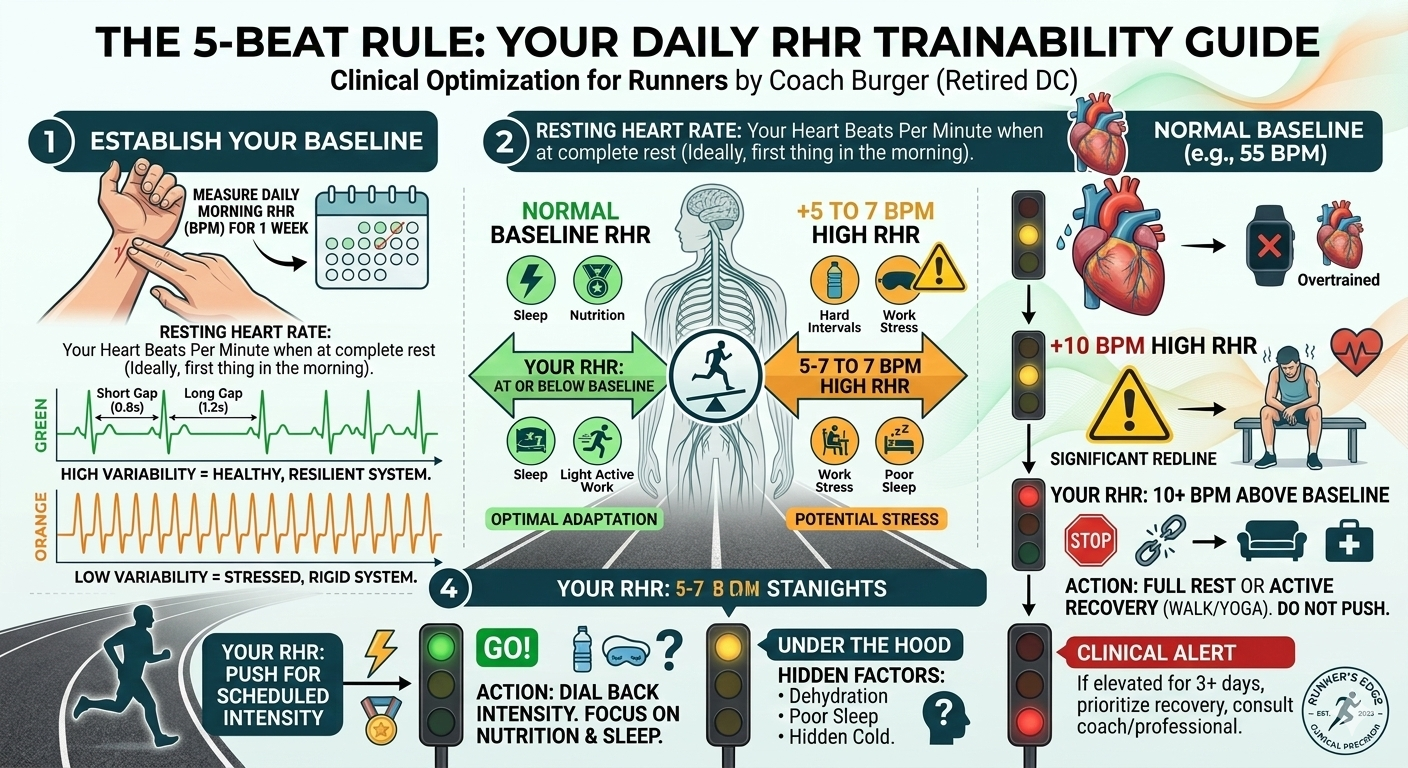
If you can’t monitor HRV, follow the “5-Beat Rule.” Establish your baseline by taking your pulse for one minute every morning for a week.
The “Hidden” Factors That Spike Your RHR
As a chiropractor, I looked at the body as a whole system. If your RHR is high, it might not just be your running. It could be:
-
Dehydration: Less blood volume means the heart has to beat faster to move what’s left.
-
Inflammation: Whether from a hard leg day or a desk-job posture causing spinal stress, inflammation keeps the body in a “high-alert” state.
-
Elevation/Heat: If you’re traveling or the humidity spikes, your heart works harder to cool you down.
-
Overtraining: If your RHR stays elevated for 3+ days, you are likely in a state of “functional overreach.”
The Bottom Line
You don’t need a $500 smartwatch to be an elite recoverer. By simply placing two fingers on your wrist every morning, you can “listen” to what your heart is telling you. If the number is up, the ego needs to go down. Listen to the data, protect your recovery, and you’ll hit that PB.