
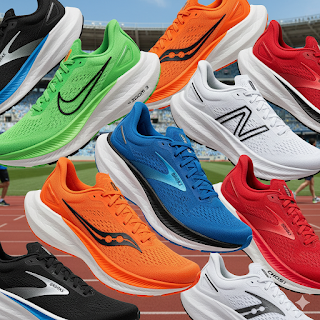
If you’re an age-group runner, chances are you’ve found a running shoe you like and stick with it until it wears out. Many runners even buy two pairs of the exact same shoe and alternate them, assuming that counts as shoe rotation. While alternating pairs can extend shoe life, it does not provide the full benefits of true shoe rotation.

True shoe rotation means using different models with different characteristics, not just multiple copies of the same shoe.
Here are three reasons why age-group runners should rotate their running shoes—and why variety matters.
1. Shoe Rotation Reduces Repetitive Stress and Injury Risk
Running places repeated stress on your muscles, tendons, and joints. When you run in the same shoe model every day—even if it’s a different pair—the stress patterns on your body remain nearly identical.
True shoe rotation introduces small but meaningful differences in cushioning, heel drop, stack height, and geometry. These variations slightly change how forces are distributed through your legs, reducing repetitive strain on the same tissues. Research has shown that runners who rotate different types of shoes experience fewer overuse injuries than those who use just one model.
Alternating identical shoes may help the foam recover, but it does not meaningfully change how your body absorbs impact.
2. Shoes—and Their Foams—Need Time to Recover
Running shoe midsoles compress with every step and need time to rebound. Alternating between two pairs of the same shoe can help the foam recover and extend the lifespan of the shoe, which is a good practice.
However, recovery alone is only part of the equation. True rotation goes a step further by giving your body slightly different loading patterns from run to run. This combination—foam recovery and biomechanical variety—is what makes shoe rotation most effective.
In short, two pairs of the same shoe help the shoe, but different shoes help your body.
3. Different Runs Require Different Shoes
Not all runs have the same purpose. Easy runs, long runs, speed sessions, and races place different demands on your legs. Wearing one shoe for everything forces a single design to handle all workloads.
A real shoe rotation allows you to match footwear to the run:
-
A cushioned, stable shoe for easy and long runs
-
A lighter or more responsive shoe for workouts
-
A race-focused shoe for events or time trials
This variety improves comfort, performance, and durability while reducing overuse stress.
What a True Shoe Rotation Looks Like
A simple and effective rotation for age-group runners includes two different shoes, not duplicates:
-
One durable daily trainer
-
One lighter or more responsive shoe
Buying two identical pairs may extend shoe life, but it’s not true rotation.
Final Thoughts
Shoe rotation isn’t about owning more shoes—it’s about smarter training. For age-group runners, rotating different types of running shoes helps reduce injury risk, improves comfort, and supports long-term consistency.
If you run several days per week, consider adding variety to your footwear, not just backups. Your body will thank you.
Ready to achieve your personal best, guided by a coach who understands running from the inside out? Hire Coach Burger, an elite private running coach and retired Doctor of Chiropractic, who combines championship-level training with a professional mastery of human biomechanics.
Coach Burger brings an unparalleled understanding of functional movement and injury prevention to every session. This clinical approach ensures that not only do you train harder, but you train smarter and safer. Coach Burger’s core coaching philosophy centers around his belief that most runners run too hard on their easy days and too easy on their hard days, ultimately failing to maximize their potential.
This strategic and biomechanically sound methodology yields exceptional results across all disciplines: Coach Burger’s athletes include twelve State Champion hurdlers, a State Champion 4x800m Relay Team, and eleven All-State distance runners (XC, 1600m, 3200m) as well as recreational runners from the 5k to the marathon. Whether you are targeting a marathon, improving track speed, or seeking an injury-proof running career, choose the coach with the clinical expertise to build you into a true champion.
You can reach Coach Burger at [email protected]. Look for his website runnersedgecoaching.com to launch soon.