
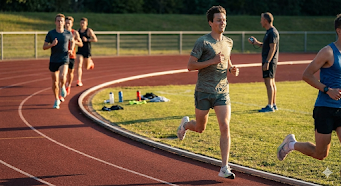
For many distance runners, “speed work” is a daunting phrase associated with gasping for air on a track. However, one of the most effective tools for

improving performance isn’t a grueling interval session, but rather high-volume strides at mile pace.
Strides are short bursts of faster running, typically lasting 15 to 20 seconds, focused on form and fluidity rather than all-out effort.
Why High-Volume Strides Matter
The primary benefit is neuromuscular adaptation. By running at mile pace, you teach your brain and muscles to coordinate more efficiently at higher speeds.
Additionally, high-volume strides help maintain “pop” in your legs during high-mileage blocks. They prevent the “plodding” gait that can develop when you only run easy miles, ensuring your fast-twitch muscle fibers remain recruited and ready for race day.
How to Perform Proper Mile-Pace Strides
Precision is more important than power. Follow these steps for the perfect stride:
-
Find a Flat Surface: A synthetic track or a smooth, flat stretch of turf is ideal to minimize impact.
-
The Build-Up: Spend the first 5 seconds gradually accelerating until you hit your mile pace.
-
The Hold: Maintain that pace for 10–12 seconds. Focus on a tall posture, midfoot strike, and relaxed shoulders.
-
The Deceleration: Gently coast to a stop over the final 5 seconds.
-
Full Recovery: This is not an interval workout. Walk or light-jog for 60–90 seconds between each stride. Your heart rate should drop significantly before the next rep.
Deciding on Volume: How Many is Enough?
Volume should be progressive. If you are new to speed work, start with 4 to 6 strides after an easy run twice a week. As your tendons and muscles adapt, increase the count.
-
Maintenance: 8–12 strides.
-
Performance Boost: 15–25 strides.
The goal of “high volume” (15+) is to accumulate time at goal speed without the metabolic fatigue of a full track session. If your form starts to break down or you feel “tight,” stop the session immediately.
The Ingebrigtsen Influence
A stellar example of using speed-specific movement to dominate distance is Jakob Ingebrigtsen. While famous for “double threshold” training, the Ingebrigtsen method heavily emphasizes technical efficiency. He often utilizes short, fast repetitions and specific drills to ensure that even during massive aerobic blocks, the body never forgets how to move at a world-class clip. For Him, speed is a skill that must be practiced daily, not just a physical capacity.
Ready to achieve your personal best, guided by a coach who understands running from the inside out? Hire Coach Burger, an elite private running coach and retired Doctor of Chiropractic, who combines championship-level training with a professional mastery of human biomechanics.
Coach Burger brings an unparalleled understanding of functional movement and injury prevention to every session. This clinical approach ensures that not only do you train harder, but you train smarter and safer. Coach Burger’s core coaching philosophy centers around his belief that most runners run too hard on their easy days and too easy on their hard days, ultimately failing to maximize their potential.
This strategic and biomechanically sound methodology yields exceptional results across all disciplines: Coach Burger’s athletes include twelve State Champion hurdlers, a State Champion 4x800m Relay Team, and eleven All-State distance runners (XC, 1600m, 3200m) as well as recreational runners from the 5k to the marathon. Whether you are targeting a marathon, improving track speed, or seeking an injury-proof running career, choose the coach with the clinical expertise to build you into a true champion.
You can reach Coach Burger at [email protected]. Look for his website runnersedgecoaching.com to launch soon.