
If you are anything like me, you are likely obsessed with data, that’s why I love My Garmin Forerunner 265. You track your pace, your mileage, and your cadence, even carefully monitor the mileage on each pair of shoes. But what if I told you the most important metric for smashing your next PB isn’t how fast you ran yesterday, but how well your nervous system is handling the stress of your life today?
As an elite coach and a retired Doctor of Chiropractic, I view the body as a complex biomechanical machine. To keep that machine running at peak performance, we have to look deeper than just muscle soreness. We have to look at Heart Rate Variability (HRV).
What Exactly is HRV?
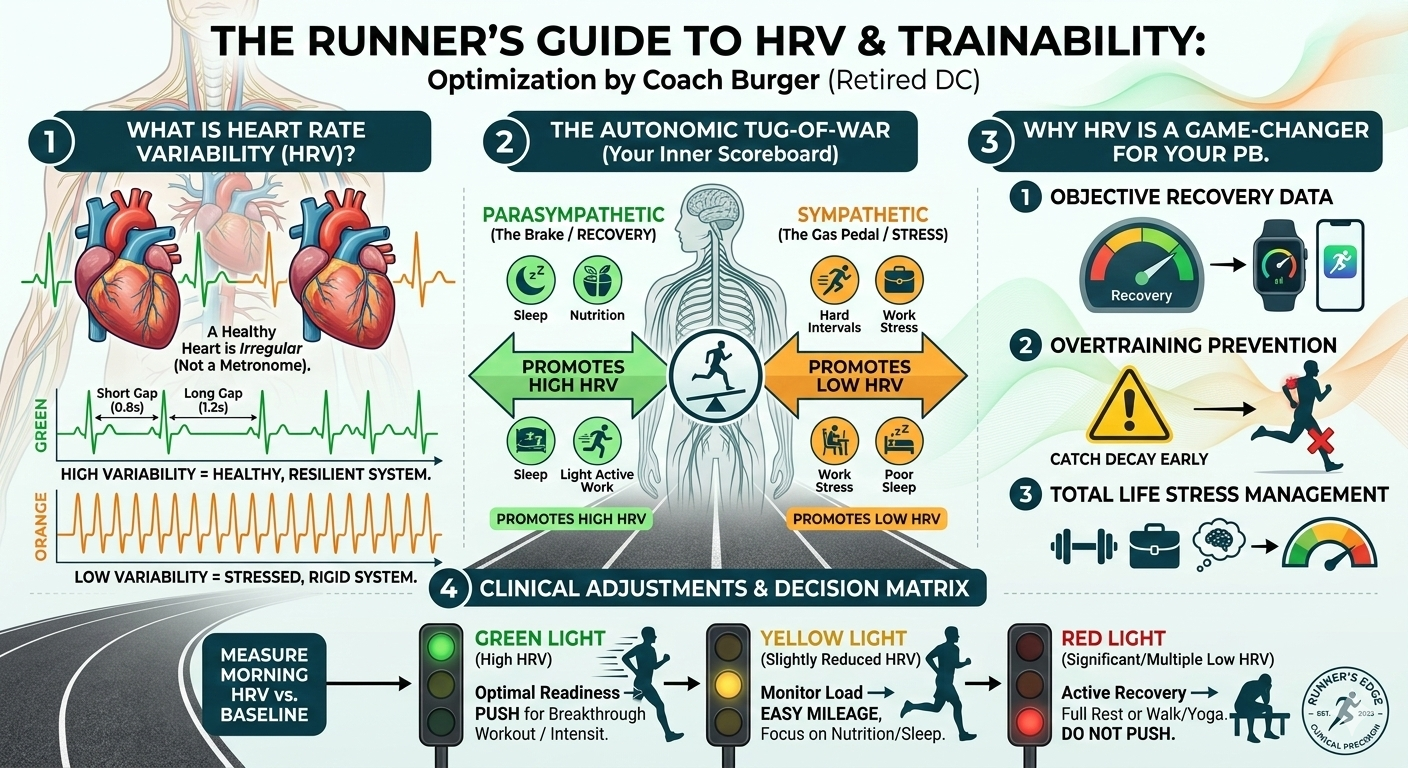
Most people think the heart beats like a metronome—perfectly steady. In reality, a healthy heart is actually a bit “irregular.” Heart Rate Variability is the measure of the time difference between each individual heartbeat.
If your heart beats at 60 beats per minute, it doesn’t beat exactly once every second. There might be 0.9 seconds between two beats and 1.1 seconds between the next.
-
High HRV: This is good! It means your nervous system is balanced, resilient, and ready to tackle a hard workout.
-
Low HRV: This is a warning sign. It means your body is under stress, stuck in “fight or flight” mode, and needs more recovery.
The Nervous System Tug-of-War
Your body has two branches of the autonomic nervous system: the Sympathetic (the gas pedal/stress) and the Parasympathetic (the brake/recovery).
When you do a grueling interval session, you’re pushing the gas pedal. When you sleep and eat well, you’re hitting the brakes. HRV is the “scoreboard” for this tug-of-war. From my clinical perspective, monitoring HRV allows us to see “under the hood” of your recovery before you even feel a twinge of an injury or the sluggishness of overtraining.
Why Every Runner Needs to Track HRV
In my coaching system, we use HRV for three primary reasons:
1. Objective Recovery Data Sometimes your legs feel heavy, but your HRV is high—that means you’re actually ready to train through the “sludge.” Other times, you might feel great mentally, but a low HRV tells us your central nervous system is fried. HRV removes the guesswork.
2. Overtraining & Injury Prevention Chronic low HRV is a massive red flag for overtraining syndrome. By catching a downward trend early, we can pivot your training plan, swap a tempo run for an easy walk, and prevent a “pop” in a hamstring or a stress fracture before it happens.
3. Total Life Stress Management Your body doesn’t know the difference between “work stress,” “poor sleep,” and “running stress.” It’s all just stress. HRV tracks the total load on your system. If you had a stressful week at the office or classroom and didn’t sleep, your HRV will reflect that, telling us to dial back the intensity to keep you healthy.
How to Use HRV to Hit Your PB
I recommend my athletes use a wearable (like a Garmin, Coros, or Oura) to track their “baseline” HRV. Once we know your “normal,” we can make clinical adjustments to your training:
-
High HRV Today? Green light. This is the day to push for that breakthrough workout.
-
Significant Drop in HRV? Yellow light. We might keep the mileage but drop the intensity.
-
Multiple Days of Low HRV? Red light. Full rest or active recovery only.
The Bottom Line
Training hard is only half the battle. To be an elite runner, you must be an elite recoverer. By monitoring your HRV, you aren’t just guessing—you’re using clinical data to ensure every mile you run is actually making you faster.
Closing Caution
Don’t compare HRV with your training partner’s. Your HRV is yours, high is going to be relative to your baseline number. For me at almost 65 years old, my baseline is around 45ms. For many of my younger athletes it is in the area of 75ms. The key to successfully monitoring your HRV is knowing the direction it is trending in.