
We’ve all seen the standard hydration advice: “Drink eight glasses of water a day,” or “Take a few sips from the water fountain during your workout.” For a certain subset of the population, that advice isn’t just useless—it’s borderline comical.
If you are a high-volume sweater—someone who steps off a 45-minute summer run looking less like you went for a jog and more like you just crawled out of a swimming pool—your physiology operates on entirely different math. I’m talking about the kind of sweat rate where a standard 4-inch headband hits total saturation 15 minutes into a workout, transforming from a wicking tool into a soaked sponge that dumps a localized flash flood directly into your eyes.
This isn’t a fitness anomaly or a sign of being out of shape; it’s often a lifelong, primary physiological trait where your internal thermostat is hardwired to open the floodgates the second the engine gets hot. But beyond the sheer annoyance of blinded vision and soaked socks, what does this massive fluid turnover actually do to your athletic performance?
The answer lies in the hidden physics of acute dehydration and blood volume.
The Brutal Math of the Trail
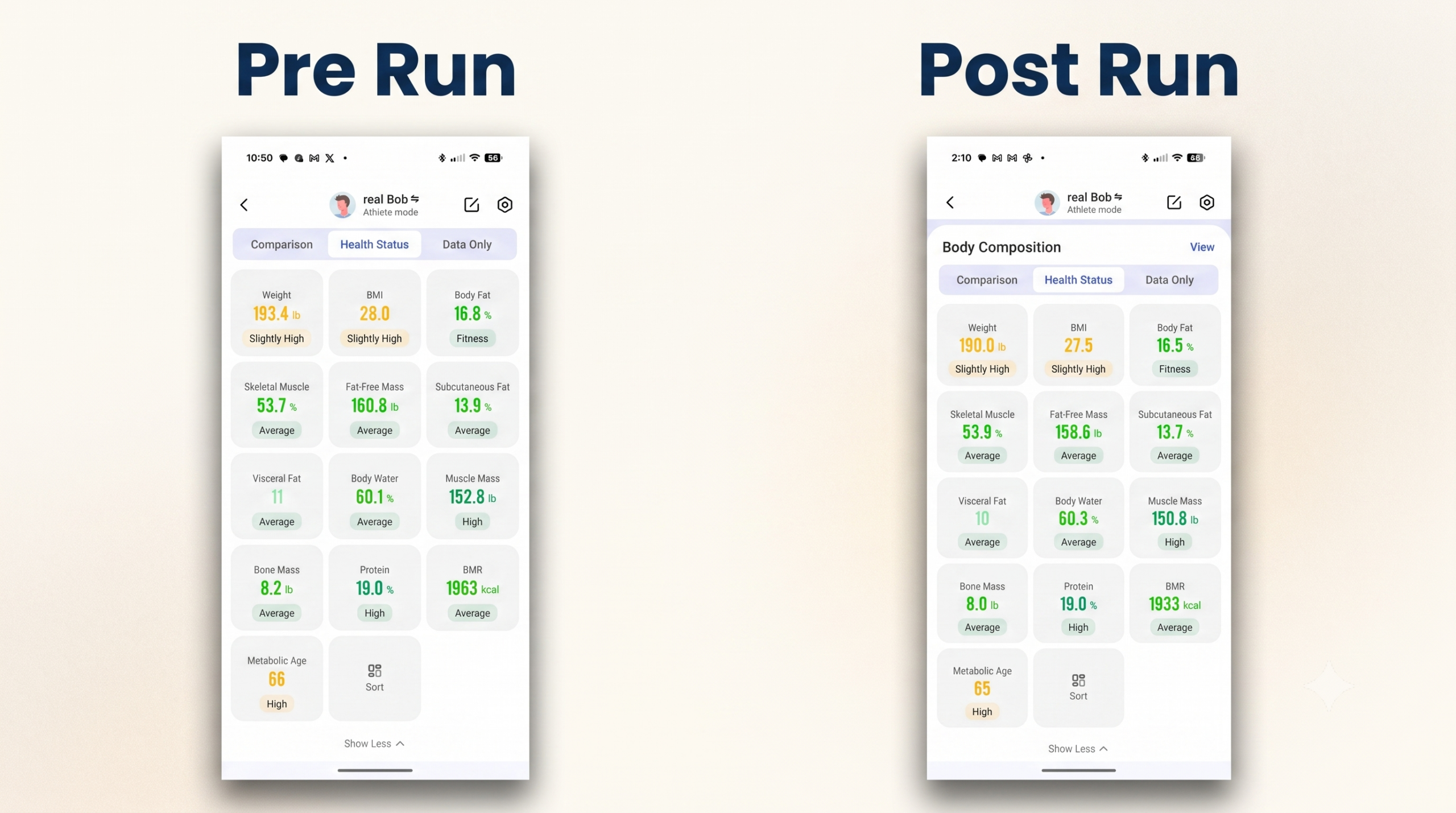
To understand the performance drain, you have to look at the hard data. On a recent 85°F day, I tackled a 5-mile trail run that clocked in at exactly 61 minutes. I stepped on the scale at a baseline of 193.4 pounds. Before hitting the trail, I packed in 54 ounces of functional fluid (a mix of nitric oxide boosters, Gatorade Endurance, and a half-teaspoon of sea salt) to prime the pump—bringing my actual starting trailhead weight to 196.9 pounds. I drank another 22 ounces during the effort.
When I finished, before stepping back on the scale, I drank a 27-ounce post-run whey protein shake (approx. 1.7 pounds) to kickstart recovery. My final post-run scale weight read 190.0 pounds.
Let’s recalculate the true, staggering sweat math:
That is an unbelievable 10.0 pounds of sweat (roughly 4.7 liters or 160 ounces) evacuated from my body in just 61 minutes.
A Warning on Post-Run Data Illusions
If you look closely at a bioelectrical impedance smart scale immediately after a high-volume run like this, the screen will present some alarming metrics. In my case, even after consuming 27 ounces of a recovery shake, the scale claimed I miraculously “lost” 2.0 pounds of pure muscle mass and 2.2 pounds of fat-free mass in just an hour.
Don’t panic—your body hasn’t cannibalized its own muscle tissue during a short trail run. Smart scales work by sending a weak electrical current through your legs to measure resistance. Because muscle tissue holds water, it acts as a primary conductor. When you sweat out a massive 10 pounds of fluid, you strip that water right out of your extracellular spaces. Even with a recovery shake in your stomach, your cells are severely dehydrated. The scale encounters massive electrical resistance, misinterprets the missing conductivity, and completely blinds its own algorithm. The drop is pure fluid, not muscle.
The Performance Price: Cardiovascular Drift and Slugging
A 10-pound fluid loss represents a massive 5.1% of total body weight vanished in 61 minutes. In sports science, crossing the 2% dehydration threshold is where the performance cliff begins. When you hit 5%, you enter a critical, borderline dangerous zone.
Here is exactly what happens inside your engine when the floodgates open that wide:
1. Thicker Blood, Harder Pumping
Sweat isn’t magic; it comes directly from your blood plasma. As you dump liters of fluid onto your forehead and shirt, your blood volume drops and your blood physically thickens. Viscous blood is much harder to pump. To maintain oxygen delivery to your working muscles, your heart has to beat significantly faster just to keep up with the same pace. This is known as cardiovascular drift. Your heart rate spikes, your perceived exertion goes through the roof, and suddenly a pace that should feel comfortable feels like a maximum effort.
2. The Cooling Catch-22
To keep you from overheating, your body vasodilates—sending a massive rush of warm blood to the surface of your skin (especially highly vascular areas like your face and scalp) to radiate heat away. But if your blood volume is drastically reduced from heavy sweating, your body faces a crisis: does it send the remaining blood to the skin to keep you cool, or does it send it to the quadriceps to keep you moving? The body will always prioritize survival over your pace. Skin blood flow compromises, your core temperature skyrockets, and your performance plummets.
Engineering the Solution: Hyper-Hydration
So, how do high-volume sweaters survive without the engine seizing on the trail? You have to self-engineer a fluid cushion.
If I had gone out into that 85°F heat without that massive 54-ounce pre-run intake, dropping over 5% of my body weight would have triggered acute cramping, a skyrocketing heart rate, and metabolic failure. The only reason I was able to successfully slug through those 5 miles is because that heavily salted pre-run protocol acted as an artificial fluid armor.
By consuming a concentrated sodium solution (like Gatorade Endurance spiked with a half-teaspoon of sea salt) 30 minutes before the run, you create an osmotic sponge in your vascular system. The sodium locks that water into your bloodstream, expanding your plasma volume before you start generating movement heat. Your body burns through that entire artificial cushion first, protecting your working muscles and vital organs from the worst of the cellular dehydration.
If you are a heavy sweater, stop fighting your genetics with tiny sips of plain water. Move your vasodilating supplements (like nitric oxide boosters) to post-run so you don’t artificially open the facial floodgates early, lean heavily into aggressive pre-run sodium loading to lock fluid in your veins, and use a mechanical wax line above your eyebrows to steer the inevitable overflow away from your eyes. Treat your hydration like the precision engineering project it is, and your performance will follow.
Ready to achieve your personal best, guided by a coach who understands running from the inside out? Hire Coach Burger , an elite private running coach and retired Doctor of Chiropractic, who combines championship-level training with a professional mastery of human biomechanics.
Coach Burger brings an unparalleled understanding of functional movement and injury prevention to every session. This clinical approach ensures that not only do you train harder, but you train smarter and safer. Coach Burger’s core coaching philosophy is that most runners run too hard on their easy days and too easy on their hard days, ultimately failing to maximize their potential.
This strategic and biomechanically sound methodology yields exceptional results across all disciplines: Coach Burger’s athletes include twelve State Champion hurdlers, a State Champion 4x800m Relay Team, and eleven All-State distance runners (XC, 1600m, 3200m) as well as recreational runners from the 5k to the marathon. Whether you are targeting a marathon, improving track speed, or seeking an injury-proof running career, choose the coach with the clinical expertise to build you into a true champion.
You can reach Coach Burger at [email protected].