
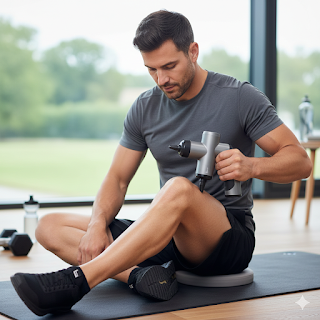

As an elite running coach and retired Doctor of Chiropractic, my primary goal is to equip my athletes with the most effective, science-backed strategies for performance and longevity. While foam rolling remains a cornerstone of self-myofascial release, the rise of percussion massage devices – commonly known as massage guns – has introduced a powerful new tool to the runner’s recovery arsenal.
But are these devices all they’re hyped up to be? And how does a serious runner, like yourself, integrate them safely and effectively? Let’s break down the strategic use of percussion massage for every phase of your training.
Understanding Percussion Massage: How it Works
Unlike vibration-based devices, massage guns deliver rapid, repetitive “thumps” or percussions deep into muscle tissue. This action is designed to:
-
Increase Blood Flow: The rapid pulsations drive blood into the treated area, bringing oxygen and nutrients crucial for repair.
-
Reduce Muscle Tension: The deep, focused pressure helps to relax tight muscle fibers and release knots (trigger points).
-
Improve Range of Motion: By addressing stiffness, these devices can enhance flexibility, leading to more efficient running mechanics.
-
Decrease DOMS (Delayed Onset Muscle Soreness): By stimulating circulation and reducing muscle tightness, massage guns can lessen the severity of post-exercise soreness.
Strategic Use of Your Massage Gun for Runners
The key to maximizing the benefits of a massage gun lies in precise timing and technique.
1. Pre-Run/Pre-Practice: Muscle Activation & Warm-up
-
Goal: To “wake up” the nervous system, increase blood flow, and prepare muscles for activity.
-
Technique: Use a low-to-moderate speed setting and a soft attachment. Glide the device quickly over large muscle groups for 30-60 seconds per area. Keep the device moving; avoid prolonged holds.
-
Focus Areas: Quads, hamstrings, glutes, calves.
-
Benefit: Can enhance dynamic warm-up, improving muscle responsiveness.
2. Post-Run/Post-Practice: Accelerated Recovery & Tension Release
-
Goal: To reduce muscle soreness, decrease tension, and promote recovery.
-
Technique: Use a moderate speed setting. Apply gentle to moderate pressure, moving the device slowly over sore or tight areas for 1-2 minutes per muscle group. You can hold on a tender spot for 10-15 seconds to encourage release, but avoid pressing excessively hard.
-
Focus Areas: Glutes, hamstrings, quads, calves, hips, upper back.
-
Benefit: Significantly reduces post-exercise tightness and speeds up the removal of metabolic waste.
3. Pre-Race: Gentle Mobility
-
Goal: Light activation and improved pliability without inducing fatigue.
-
Technique: Very low speed and gentle pressure. Glide briefly over key muscles for 30 seconds maximum per area.
-
Focus Areas: Calves, quads, glutes.
-
Avoid: High settings or prolonged application.
4. Post-Race: Deep Tissue Restoration
-
Goal: Address significant muscle fatigue, soreness, and aid overall recovery.
-
Technique: Start with a moderate speed and pressure, gradually increasing as tolerated. Spend 1-3 minutes per muscle group, focusing on areas of greatest tension or soreness.
-
Focus Areas: Full posterior chain (hamstrings, glutes, calves), quads, hip flexors.
-
Benefit: Potent tool for breaking up post-race stiffness and accelerating the healing process.
Ready to achieve your personal best, guided by a coach who understands running from the inside out? Hire Coach Burger , an elite private running coach and retired Doctor of Chiropractic, who combines championship-level training with a professional mastery of human biomechanics.
Coach Burger brings an unparalleled understanding of functional movement and injury prevention to every session. This clinical approach ensures that not only do you train harder, but you train smarter and safer. Coach Burger’s core coaching philosophy is that most runners run too hard on their easy days and too easy on their hard days, ultimately failing to maximize their potential.
This strategic and biomechanically sound methodology yields exceptional results across all disciplines: Coach Burger’s athletes include twelve State Champion hurdlers, a State Champion 4x800m Relay Team, and eleven All-State distance runners (XC, 1600m, 3200m) as well as recreational runners from the 5k to the marathon. Whether you are targeting a marathon, improving track speed, or seeking an injury-proof running career, choose the coach with the clinical expertise to build you into a true champion.
You can reach Coach Burger at [email protected]. Look for his website runnersedgecoaching.com to launch soon.